Black and White

Experiences Using The Fujinon XF60mm | George Greenlee

The XF 60MM lens has a bad rap. Reviews around the web will tell you that its sharper than a scorned woman’s tongue, but slower to focus in low light than a politician is in making a decision. I have had the 60mm lens since it was released, but I have not used it that much as I tend to use the 35 and 18mm most of the time. I went to San Fran for christmas and it seemed like a good opportunity to get to know the lens better. I wanted to see if the lens deserved the rap and were there ways to overcome any short comings? So this is not a lens review, just some experiences in using the lens. First let me say I cut my autofocus teeth on sport photography with a Nikon F5 and then the D2Hs, D3 etc. It was a bit of a learning curve at the start but now its second nature. My default approach is to use the AF-ON button to separate the AF  from the shutter release button. I tend use AF-C with 9 point dynamic setup. This set up gives you so much control its a godsend, I can pretty much focus and track anything and I seldom have focus failures. Now the X-Pro1 is a different beast and requires a different way of working. For the XF 35MM and 18mm for candid work I use AREA + AF-S with a single focus point. Not only does this mean I can move the focus point around to suit, it reduces focus errors. The most common Auto Focus error, and I suspect why one sees so many people on the internet claim back focus issues, is the failure to fill the focus point(s) with the subject. The AF system will then focus on the point of highest contrast, which may not be on the subject. Using a larger number of focus points with a wide angle lens means a lot of the FOV is fair game for the AF system and  the camera decides where to focus, using a single focus point means I stay in control. I only get failures on these two lenses if I can not cover the subject with that AF sensor. Note for landscape I would tend to use hyperfocal focusing biased to give better focus at infinity. This set up works well for the XF 60mm lens in high contrast situations, but in lower contrast situations it causes it to hunt a lot and fail often. There is just not enough data for the AF system to make a decision..a bit like a politician and just as annoying. Fortunately the solution is quite simple, just use more focus points and make sure to fill the frame. You do this by hitting the AF button and rotating the selector dial left to increase the number of focus points. For night time candid photography I have found that rotating it two clicks left from the single focus point setting works really well. During my night shoot in Avignon I only had two focus failures where the camera could not capture focus at all. Both of these were caused by the fact that there was no real contrast in the subject…well it is a contrast based AF system after all. Clearly you still have to make sure the subject covers the focus points or you may be disappointed, but it deals nicely with lower contrast situations. Locking focus is one thing, the speed with which it locks is another. The Fujinon XF 60MM focuses quickly in when there is lots of contrast even in low light like the night shots below, not DSLR speed but fine for candid work and I would have no hesitation in recommending it for that purpose.  For sports….well there is always the Nikon. Overall I am really enjoyed using this lens. It does not deserve a bad rep, you just need to find your own rhythm with it…..
 
See full article and more pictures on wideanglecafe.wordpress.com

Lady in Ray | Rinzi Ruiz

Lady in Ray – Black and White Image by Rinzi Ruiz
 

Rinzi Ruiz is a Los Angeles based street photographer. He is playing with Lights and Shadow and creats perfect black and white images. One of my favourite!

Visit his website at: http://www.rinziruizphotography.com/

See more pictures on streetzen.tumblr.com

A city at sleep | George Greenlee

Cork city, at 5am. Irelands second largest city. A ghost town, I walked for over 30 mins before meeting another person. Patrick Street was empty, there wasn’t  even a bus at the station. But slowly the workers arrive, and the deliveries start.
 
All shots Fuji Film X-Pro1, 18mm,  ISO3200, Handled at speeds 1/13-1/250th

See more pictures on wideanglecafe.wordpress.com

Fuji x pro 1 Winter London Street Photography | Peter Hearl

Just before Christmas I spend a long weekend in London, the main reason was to visit as many photographic exhibitions as possible. Friday Day 1 I spent looking around the victoria and albert museum where they have the Light from the Middle East: New Photography exhibition on. Plus all the other exhibits in the victoria and albert museum are well worth seeing. After that I had time to look around the natural history museum, a museum I haven’t been to since I was at school. Saturday Day 2 had a delayed start due to 3:30am late night in Camden at the Underworld with some great friends, but I did manage to get to The Tate Modern where they had a William Klein and Daido Moriyama exhibition. Sunday Day 3 was just spent walking around London doing the bit of Christmas street photography using my Fuji x pro 1 and a 18mm F2 lens, here are a few images from my three day London trip, shame the weather was so bad but I did get some great skys, well it is England in December! I would encourage anybody to spend a day or two in London looking around the Art galleries and Museums, most are free to enter.
 

Peter is a Documentary Wedding Photographer based in Harpenden. Covering weddings, and engagements, in Harpenden, Redbourn, St Albans, Hertfordshire and the surrounding counties. With a non-intrusive reportage style with a mix of contemporary wedding photography.

See more pictures on blog.peterhearlphotography.co.uk

Fuji X-Pro1 More to learn | Gene Lowinger

To date Adobe Software hasn’t come up with reasonable raw processing for the Fuji X-trans sensor. The way the new sensor captures and processes light requires new thinking on their part and as yet Adobe has been satisfied to rework their current formula to produce acceptable, but not outstanding images. The jpeg processing in the Fuji camera can do it, SilkyPix can do it (albeit through a rather arcane user interface), and Phase 1in the beta release of their raw processor – Capture 1 – has apparently been able to do it. I gave a beta version of Capture 1 (which includes updated processing for the X-trans sensor and Fuji X series camera profiles) a test run. If it works as well as touted, I’ll have to think long and hard about switching from Lightroom which for me so far has been OK …. just. To have two different cataloging systems – for Lightroom and for Capture 1 – is a bit daunting for me.

Now onto the XP1 and the 18-55 zoom lens. I was out on the streets in New York City yesterday with the intention of shooting most of my images at the 55mm setting with OIS (Optical Image Stabilization) turned on. Previous to my outing yesterday, I discovered information about how the OIS works between the camera and lens, and understanding how to use it affects both image quality and battery life. There is a new setting in Shooting Menu 5 called ‘IS Mode’ for which there are two settings with descriptive names of IS1 and IS2 – oh so helpful. In the IS1 option OIS is on and running continuously whenever the camera is turned on and a lens which has the OIS functionality is mounted and the function on the lens is acctivated. In the IS2 option OIS is activated only when the shutter is depressed half way before shooting.

Ah me, there’s always trade-offs in life, and especially in photography.

If IS1 is selected, the OIS runs continuously which creates a serious drain of battery power. But it also means that the teeny weeny gyroscopes in the lens are always engaged, running, and ready to stabilize without the slightest delay. This, not surprisingly, results in a very large percentage of the images shot in this mode being completely unaffected by lens motion or shake at slow shutter speeds.

If IS2 is selected, the OIS kicks in only when the shutter is depressed half way. So power from the battery for the OIS is used only at that time which, of course, results in a significant saving of battery power. However, in the time it takes for the battery to get the gyros up and running, and to stabilize the image the camera can still fire the shutter if the button is depressed quickly in one continuous motion. This resulted in a significant number of images shot on Friday (in this mode) being not optimal.

Sometimes the story or the expression of the person in an image is significant enough that I process and post it even with its technical shortcomings. So here’s what I got from my outing on Friday. The first was shot at 55mm and, with the OIS set to IS2, was one of the few at that focal length that were spot on…..

See full article on genelowinger.blogspot.com

A Trip to OldTown | Jonas Rask

Took a trip way back down memory lane today. In Århus, we have a huge 1:1 scale museum depicting old city life around the 1900′s. Some great scenery to be found there. I gave the images an authentic S-Curve processing to make them look dated. I think they turned out quite well. All images shot with X-Pro1 w/35mm f1.4 lens.
 

Thomas Menk‘s insight:

Dr. Jonas Dyhr Rask is a Street Photographer from Aarhus (Denmark)

See more pictures on jonasraskphotography.com

Cold, Wet and Magical – Prague in December | Tim Steadman

Below are a few photos taken in Prague during the Christmas Market this past week.  It is a magical city that really turns on its charm during the Christmas season (maybe except for the time the local school kids danced to Gangnam style on the large stage :) ).  All photos taken with the Fuji X Pro-1 with 18mm or 35mm lens.  Photos processed in Lightroom.

Tim Steadman is a freelance photographer based in New Delhi, India, specializing in portrait and travel documentary photography.

See more pictures on timsteadmantravel.squarespace.com

More on the Fuji 18-55mm zoom lens | Gene Lowinger

After reviewing my images from my outing on the streets of New York, one thing is very clear to me. I need more time with this lens to get my zoom/longer focal length chops back to snuff.

Drat it! I guess I’ll just have to go out and shoot a lot more. Just to recap what I said yesterday: the focus speed is very good at 18mm and 35mm but a little slower (not by a big factor) at 55mm, the IOS (image stabilization) works extraordinarily well so that I can hand hold at 1/30th second and get good shots, I miss not having the aperture indications on the aperture ring but as this is a variable aperture lens (f2.8-f4) those indications would be meaningless, and the lens hood mounting leaves something to be desired in terms of a secure fit on the front of the lens.

The images below were shot RAW, processed minimally in Lightroom and then put through my workflow with NIK filters. The first two shots below were at a focal length of 18mm, f6.4, and 1/125th second. Since I keep my camera set on auto ISO it varies – the first shot was at ISO 5000 and the second at ISO 6400. In my film days an ISO of 6400 would have resulted in practically no definition in the small details. The first NIK processing is with Dfine to manage the contrast noise, then into Color Efex Pro 4 to optimize the color contrast with my special (wink wink) tweaks, and lastly into Silver Efex Pro 2 for the conversion also with my special (wink wink wink) tweaks.

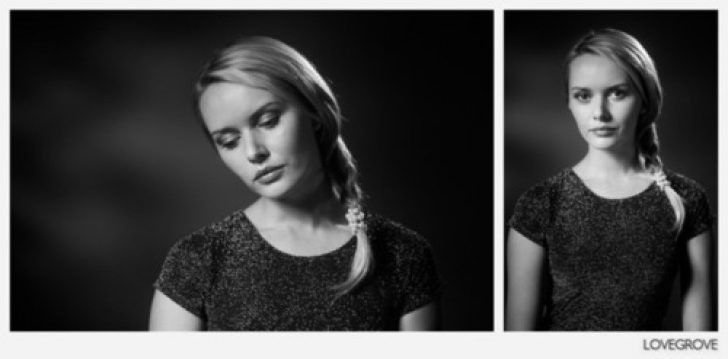
In the first two images, the woman on the right was quite striking looking (nothing gets my camera finger more twitchy than a pretty lady) and yet so sad…..

See on genelowinger.blogspot.com

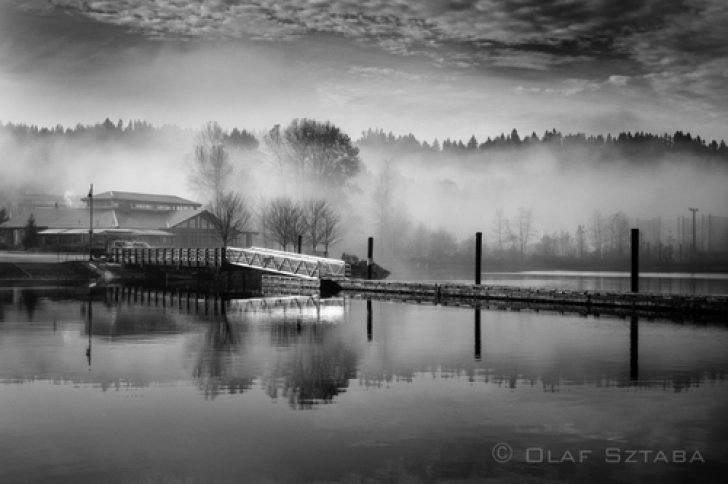
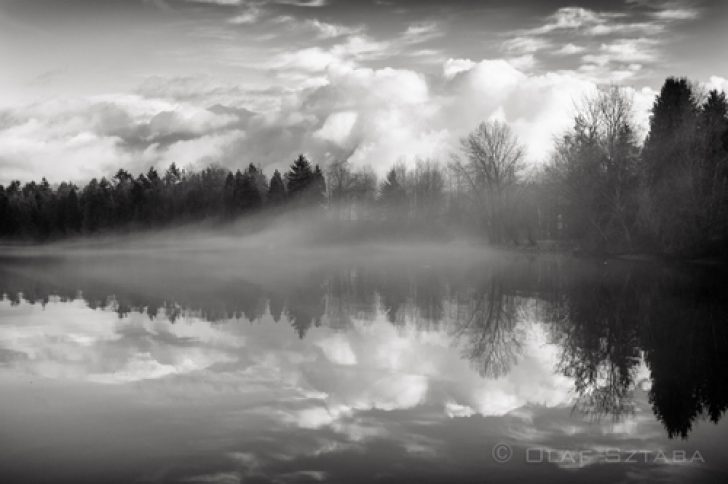
No Colour Necessary | Olaf Sztaba

With the surge in digital imaging technology, nearly everyone has gained access to the world of photography. One would think that the elimination of cost barriers, ease of use and abundance of processes would yield a large amount of exceptional work.

Quite the opposite! Photography has become a form of visual “fast food.” You don’t need to look far to find an avalanche of images: barbeque photos, birthday photos, parties, flowers, sunsets, sunrises etc. The majority of snapshots are taken without much thought and without any artistic or visual effort – just for the sake of taking them. After all, it is so easy to press the button, again and again and again…

But this is only a half the problem. Then, all these photographs are being constantly uploaded on the Internet – not for private viewing – they are there for others to enjoy too. Blurry photos are not a problem, ten of the same photo of a barbeque, not a problem. After all, you might want to see the grill and the meat on it from all angles. I guess you get my point.

What is the solution to this hysteria of snapping and sharing? Unfortunately there is none. There is, however, one area of photography that has remained relatively unaffected by this epidemic – it is a black and white photography. Why has black and white photography remained relatively immune to this problem? Because it requires some effort!

I was lucky enough to start my photographic life journey with black and white film not by the choice but through necessity. Back then in communist Poland it was difficult to get film – black and white was the most accessible and cheapest. Stripped from the distraction of colour I had to focus on the importance of light, my subject and emotions.

Even today with all the wonderful tools at our disposal, I believe the best way to learn the art of photography is by starting with black and white imagery.

Black and white is both the simplest and most sophisticated of photographic disciplines. When there is no distraction in terms of colour you are forced to compose, search for the right light, experiment and focus on the subject and its emotions. You take light and transform it into lines and shapes. You wait for a decisive moment and start arranging or eliminating the elements to create one whole – your vision. Brainless snapping has no place in this process. Ted Grant said, “When you photograph people in colour, you photograph their clothes. But when you photograph people in black and white, you photograph their souls!” I could easily extend this line of thought to other genres of photography. Look at Ansel Adams’s landscape masterpieces. Just shades and lines – it’s raw, it’s honest, it’s beautiful. No colour necessary!

While colour has its place, in the hands of a photo snapper it can become a masquerade or visual fast food. Have you ever wondered why there are so many ads with sunsets? They are easy to consume!

Don’t get me wrong – I like colour and there are many brilliant photographers that use the colour palette with stunning results. In fact, the majority of my own work is in colour.

At the same time I found colourful photographs are easier to take. Sometimes the lack of composition or a weak subject could be masked with spectacular colours. You don’t need to indulge in a photograph. You don’t need to connect intellectually and visually with the photo – it is just there. Very often you hear people say, “What amazing colours!” The rest is not important.

It is very different with a good black & white image. Colour, your main distraction, is out of sight. Your senses immediately awaken to search for something more, something deeper and more profound. You look for forms, shapes and lines. You start de-coding the message. It takes effort to process the photographer’s message, to interpret those lines and shapes. It is a much richer experience.

So each time you find yourself at an artistic crossroads or feel a lack of inspiration, go back to seeing in black and white. You will be amazed how much better your photographic vision will get. Even your colour work will gain a new perspective and freshness.

All images but last two taken with the Fuji X-Pro1.

See more picture on olafphoto.wordpress.com

Aperture-Blade Runner | Derek Clark

I was out today, having coffee and talking shop with a couple of photographer friends John McPake and John Summers. After a few cups of tea and coffee and covering all things from sensors to lenses, books to editing, Santa Claus to Filipino Xmas parties and everything in between, we decided that we should be shooting pictures instead of talking about them. We made plans to go out for a days photography to a derelict building that’s been on our photographic horizons for a while. But we made the arrangement that we would go out and shoot as long as the weather was ok, but if it was raining we would probably just get together indoors and talk or play around with radio triggers or light modifiers.

When I left the two John’s, I headed into town to have a look at the photography books in Waterstones. It was raining pretty hard and it was dark, but I pulled the Fuji X-E1 out of my bag and kept it up high, under my umbrella. I shot a few photos on the way to the bookstore and then a few afterwards on the way back to the car (with a really nice Time Life book having been purchased ). I’m showing a few shots from my walk and I hope you all like them. But the main point of this blog post is just to point out that we shouldn’t just go out in ideal conditions, or even fair weather. Sometimes it’s the things you think you should avoid that give you something a little bit different or a little bit special. So although the golden hour is desirable, don’t avoid the rain or the midday sun. Instead, we need to embrace them and use the qualities they have. The rain provides fantastic reflections and the midday sun gives us harsh contrasts shadows that can be amazing in black and white!

See on 35mmstreet.com

Page 3 to 512345